
2026

A combined experimental and theoretical investigation of the interaction between a self-assembled molecular monolayer and dissolved molecules, exploited for water cleaning by F5 (Halik), S2 (Spiecker) and M3 (Zahn):
“Magnetic Water Cleaning of Estrogens via Tight yet Dynamic Binding to Nanoparticles”
L. Müller, P. Maier, D. Vivod, W. Müller, N. Lopatik, T. M. Schichtl, J. Fröhlich, I. Kraus, M. Huck, W. Corts, C. Cafolla, L. Ruhm, H. Gaß, J. Voß, J. Byun, L. Rockmann, G. Grundmeier, K. Voïtchovsky, H.-G. Steinrück, E. Spiecker, S. Dalabasmaz, M. Pischetsrieder, E. Brunner, R.Schweins, D. Zahn, M. Halik
Adv. Sci. 2026, e77321

A systematic exploration by F4 (Bachmann) of mixed layers, a selection of which will then be developed by ALD:
“Exploration of mixed metal oxide films as urea oxidation electrocatalysts”
M. M. Dierner, J. Kollenda, M. Bosch, J. G. Padayatty, J. Bachmann
Phys. Chem. Chem. Phys. 2026, 28, 22669-22676

A study for which many CLINT and ChemPrint partners teamed up to understand the surface chemistry of gallium to enable the control of particle growth, including C1 (Bachmann), S2 (Spiecker) and M5 (Harting):
M. A. Jiménez-Sánchez, S. Carl, M. S. Moritz, J. Englhard, G. C. Antunes, N. Madubuko, B. Apeleo Zubiri, N. Taccardi, P. Malgaretti, E. Spiecker, C. Papp, J. Harting, M. Haumann, P. Wasserscheid, J. Bachmann
“A robust and versatile hot injection synthesis of catalytically active gallium-based bimetallic nanoparticles with low size polydispersity”
Mater. Adv. 2026, Advance article online

Self-assembled molecular monolayers (SAMs) applied to environmental remediation! A proposal by F5 (Halik) in collaboration with M3 (Zahn):
J. Voß, S. Prusch, L. Valencia, J. Fröhlich, L. Müller, S. Dreyer, L. Rockmann, D. Zahn, M. Halik
“Functional Nanoparticles for the Magnetic Removal of Critical Phthalates from Water”
ACS EST Water 2026, ASAP advance article

How to 3D-print a photoelectrode: a methode established by C4 (Ng) in collaboration with S2 (Spiecker), S3 (Unruh), F1 (Guldi), F4 (Bachmann), and F5 (Halik):
T. Uhlein, Z. Y. Siah, Y. Reva, M. Dierner, J. Will, K. Gubanov, D. Langford, J. Färber, K. Götz, L. Rockmann, M. Halik, T. Unruh, R. H. Fink, J. Bachmann, D. M. Guldi, E. Spiecker, P. Jiménez-Calvo, M. Palacios-Corella, S. Ng
“Scalable Photocatalytic Dye Degradation Performance by Tunable 3D-Printing of g‑C3N4/cPDA Architectures”
ACS Appl. Polym. Mater. 2026, 8, 13482-13491

A combined experimental and theoertical modeling study by M5 (Harting), S3 (Unruh) and F3 (Brabec) to unravel how printing process parameters influence microstructure and ultimately device performance:
M. Steinberger, M. Siber, H.-J. Egelhaaf, M. Wu, I. Kraus, J. Will, X. Xie, L. Bu, J. Graetz; T. Unruh, L. Lüer, E. Spiecker, A. Distler, J. Harting, C. J. Brabec, O. J. J. Ronsin
“Understanding the effect of the drying rate in process–structure–performance relationships for PM6-Y6 organic solar cells”
Energy Environ. Sci. 2026, 19, 5730-5748

New methods for the computation of excited state energies established by M1 (Görling) which improve both the computational efficiency and the accuracy:
E. Trushin, O. Bertleff, A. Görling
“Potential-Averaged ΔSCF Methods: Underlying Formalism and Evaluation of Accuracy of Excitation Energies”
J. Chem. Theory Comput. 2026, 22, 8324−8349
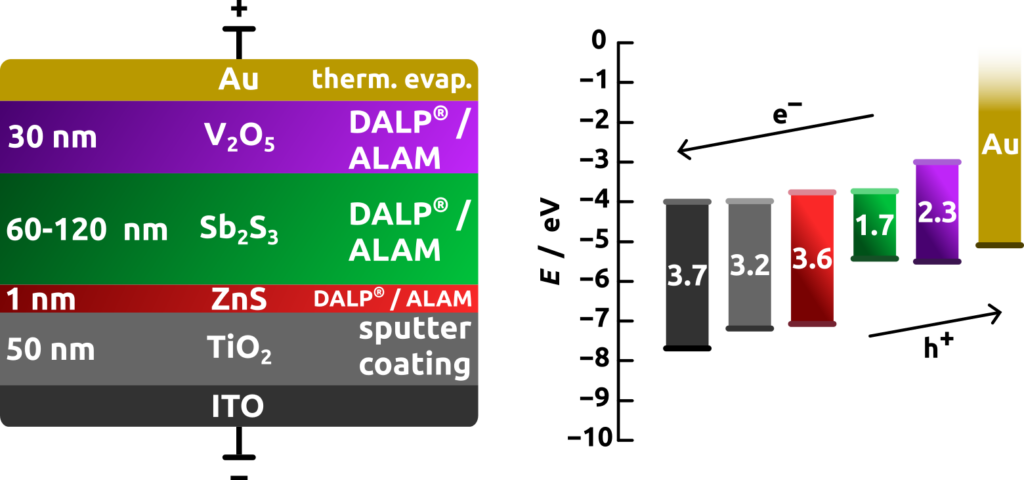
Direct pattern deposition of not only individual layers but also full functional solar cell stacks, maintaining atomic-level control: achievement unlocked in F4 (Bachmann)!
M. Mc Naire, S. Pannen, J. Englhard, P.-C. Liao, S. Kern, D. Zanders, A. Devi, R. W. Crisp, J. Bachmann
“Ultrathin Sb2S3 Solar Cells Processed by Atomic-Layer Additive Manufacturing”
Commun. Mater. 2026, 7, 180

Can photochemical reactions be controlled to yield one product and not another? C3 (Dube) and M2 (Müller) demonstrate that they are able to do just that!
M. Hartinger, H. Dube, C. Müller
“From excited-state dynamics to product selectivity: theoretical insights into the photoinduced chemistry of aza-diarylethenes”
Phys. Chem. Chem. Phys. 2026, 28, 15728–15738

F3 (Brabec) teamed up with C6 (Wisser) for a fundamental understanding of extended defects which delivers practical advantages:
L. Dong, V. Rehm, S. Qiu, Z. Han, N. H. Hemasiri, M. Wurmshuber, M. Wagner, C.-L. Tavera-Méndez, D. Wisser, C. Li, R. Basu, L. Lahn, O.Kasian, S. Feroze, W. Heiss, A. Distler, H.-J. Egelhaaf, F. Yang, C. J. Brabec
“Vapor-Phase Grain-Boundary Anchoring Enables Molecular Toughening and Record Bending Endurance in Pilot-Scale Roll-to-Roll-Printed Flexible Perovskite Modules”
Angew. Chem. Int. Ed. 2026, 65, e7292679

M5 (Harting) use phase-field methods to model nucleation and growth of halide perovskite crystals and enable deliberate positioning of individual crystals:
“Controlling Parasitic Nucleation in Methylamine-Treated Perovskite Films via Artificial Seeding and Phase-Field Simulations”
E. R. Schütz, M. Majewski, O. J. J. Ronsin, J. Harting, L. Schmidt-Mende
Small Sci. 2026, 6:e70301

Another demonstration by C2 (Hirsch) and S4 (Maultzsch) of laser patterning, this time of black phosphorus, with a control enabled by the underlying graphene layer!
“Laser-Induced Chemical Patterning of Graphene – Black Phosphorus Hybrids”
J. Eisenkolb, M. Assebban, T. Dierke, J. Maultzsch, A. Hirsch, F. Hauke
Chem. Eur. J. 2026, 32, e71127

F6 (Peters) demonstrate with C6 (Wisser) and F3 (Brabec) how to recycle the ions of a perovskite solar cell and maintain performance by readjusting the ratio of ions!
“Composition Restoration Enables Recycling of Mixed-Cation, Mixed-Halide Perovskites for Solar Cells”
Z. Wu, K. Dammer, R. Skunde, M. Sytnyk, C. Göllner, F. Ding, J. S. Rocha-Ortiz, A. These, B. Imre, Y. Wang, D. Wisser, C. Brabec, I. M. Peters
Adv. Mater. 2026, 38, e73266

C2 (Hirsch) and S4 (Maultzsch) join forces to fine-tune laser patterning of 2D materials using electrochemical control:
“Electrochemical Modulation of Laser-Induced Covalent Functionalization of Graphene”
T. Nagel, L. Feuerstein, K. Gerein, S. Wolff, J. Maultzsch, A. Hirsch, I. M. Weidinger, F. Hauke
Adv. Sci. 2026, 13, e75454

A systematic characterization by C5 (Libuda) of the transformations occurring on a metal surface upon electrochemical treatment:
“Surface oxidation of Ru(10-10) and Pt–Ru/Ru(10-10) electrocatalysts and its effect on the hydrogen evolution reaction”
R. Hübsch, D. Schauermann, J. Škvára, S. Reindl, T. Skála, N. Tsud, T. Retzer, J. Mysliveček, O. Brummel, Y. Lykhach, J. Libuda
Electrochim. Acta 2026, 570, 148959

M5 (Harting) develop phase-field methods for modeling phase separation behavior in direct correlation with experimentally observed morphologies:
“Interplay of Crystallization and Amorphous Spinodal
Decomposition During Thermal Annealing of Organic
Photoactive Layers”
M. Siber, O. J. J. Ronsin, G. L. Frey, J. Harting
Adv. Sci. 2026, 13, e24140

S2 (Spiecker), S3 (Unruh) and F3 (Brabec) develop electron diffraction methods for beam-sensitive semiconductor materials:
“3D electron diffraction—the missing slice completing nanoscale analysis of organic solar cells in TEM”

I. Kraus, M. Wu, S. Rechberger, J. Will, S. Maiti, K. Dengel, A. Kuhlmann, M. Huck, L. Lüer, F. Bertram, H.-G. Steinrück, T. Unruh, C. J. Brabec, E- Spiecker
Nature Communications 2026, 17, 3159
https://doi.org/10.1038/s41467-026-70690-y
https://www.fau.de/2026/04/news/forschung/elektronen-die-alleskoenner/


A contribution by C1 (Bachmann) to understanding the ligand chemistry of metal sulfide surfaces:
“Decomposition Pathways of Thioureas in Oleylamine Control Reactive Sulfur Species in SrS Nanocrystal SynthesisClick to copy article link”
V. Mauritz, N. Ruhland, J. Englhard, F. Steiger, M. E. Pérez-Ojeda, J. Bachmann, R. W. Crisp
Chem. Mater. 2026, 38, 2680-2689

A surface science study in project C5 (Libuda) demonstrates that on a cobalt oxide substrate, the ALD precursor hydrogen sulfide compounds acid-base chemistry with redox reactivtiy:
“Redox Dynamics of Co3O4(111) During H2S Adsorption and Decomposition: A Synchrotron Radiation Photoelectron Spectroscopy Study”
J. Hauner, T. Skála, N. Tsud, F. Stavale, Y. Lykhach, J. Libuda
ChemCatChem 2026, 18, e01491

Some molecular insight delivered by C6 (Wisser) and S2 (Spiecker) into surface photoreactions triggered by light inside the nuclear magnetic resonance spectrometer, inside the sample holder spinning at more than 10 kHz — a tool that we will exploit further for photopatterning substrates in ChemPrint:
“Operando Magic Angle Spinning Solid-State NMR Spectroscopy of Methanol Photoreforming Over Titania-Coated Silica Monoliths”
F. Ding, K. König, J. Böhmer, F. M. Wisser, E. Spiecker, B. Apeleo Zubiri, D. Wisser
Chem. Eur. J. 2026, 32, e03583

A process for 3D-printing semiconductors with atomic precision using the self-limiting surface chemistry of ALD: It is called atomic-layer additive manufacturing (ALAM) and we have established it for In2S3, to be used as a dopant, in a collaboration between ChemPrint projects S2 (Spiecker) and F4 (Bachmann):
“Atomic-layer additive manufacturing of indium(III) sulfide”
Y. A. Galván Dominguez, S. Khaled, T. Yokosawa, J. Will, S. Kürten, M. Mc Naire, E. Spiecker, L. Bergaoui, J. Bachmann
Chem. Afr. 2026, 9, 43

Beyond 25% PCE! Stable for over 1000 hours! A SnO2 layer by ALD to interconnect the two cells in a tandem! All this, and more, in this paper by project F3 (Brabec) in collaboration with C1/F4 (Bachmann), S2 (Spiecker) and S5 (Bär):
“A simultaneous synergistic protection mechanism in hybrid perovskite–organic multi-junctions enables long-term stable and efficient tandem solar cells”
C. Liu, K. Zhang, X. Zhou, M. Wu, P. Weitz, S. Qiu, A. Vincze, Y. Bai, M. A. Anderson, J. Frisch, R. G. Wilks, M. Bär, Z. Peng, C. Li, J. Tian, J. Zhang, J. Wu, J. Englhard, T. Heumüller, J. Hauch, Y. Huang, N. Li, J. Bachmann, E. Spiecker, C. J. Brabec
Energy Environ. Sci. 2026, 19, 1137-1147

A study led by F3 (Brabec) on integrating a sustainable electrode material into perovskite cells, with C1 (Bachmann) contributing an ALD layer that adjusts the band edge alignments:
“Enhancing the viability of p-i-n perovskite solar cells with printable carbon cathode: Origin of polarity inversion”
T. Du, H. U. Dag, Z. Peng, J. Englhard, A. Barabash, H. Zhang, J. Zhang, J. Tan, S. Qiu, L. Dong, M. Wagner, J. A. Hauch, F. Guo, O. Kasian, J. Bachmann, C. J. Brabec
Joule 2026, 10, 102224

Collaboration between project partners C1 & F4 (Bachmann), C5 (Libuda), C6 (Wisser), F1 (Guldi), F3 (Brabec), M2 (Müller) and M3 (Zahn) for the development of a solution ALD method towards a halide perovskite and its functional application in photovoltaics:
”Solution ALD of (CH3NH3)(PbI3) Perovskite Thin Films Yields Functional Quality and Stability Superior to Classical Processing”
V. M. Koch, X. Zeng, A. S. Deckert, P. Büttner, E. Franz, F. Ding, M. A. Anderson, J. Zhang, C. Kupfer, E. A. Mack, V. K.Ambasta, P. Duchstein, K. E. Dehm, S. Furxhiu, A. Zahl, J. Frisch, F. Hoga, T. Stubhan, R. G. Wilks, Z. Peng, O. Brummel, R. W. Crisp, D. Zahn, C. Müller, D. M. Guldi, M. Bär, D. Wisser, J. Libuda, C. J. Brabec, J. Bachmann
Angew. Chem. Int. Ed.2026, 65, e13903.
2025

F3 (Brabec) unravel the fundamentals of perovskite crystallization to enable their formation as large-scale films via blade coating:
“Balancing the supersaturation rate and coordination capability for upscaling high-performance perovskite photovoltaics”
W. Peng, J. Wei, H. Li, W. Feng, M. Liu, T. Xu, S. Qiu, C. Liu, M. Wagner, A. Distler, C. J. Brabec, Y. Mai, F. Guo
Energy Environ. Sci. 2025, 18, 9917-9926

Collaboration between project partners C3 (Dube), F1 (Guldi) and M2 (Müller) for controlling molecular photoreactions:
“From Triplet to Twist: The Photochemical E/Z-Isomerization Pathway of the Near-Infrared Photoswitch peri-Anthracenethioindigo”
M. Hartinger, M. Herm, C. Schüßlbauer, L. Köttner, D. M. Guldi, H. Dube, C. Müller
Angew. Chem. int. Ed. 2025, 64, e202510626

Collaboration between project partners C2 (Hirsch) and S4 (Maultzsch) for exploiting surface photoreactions to pattern transition metal dichalcogenides:
“Patterned Assembly of Transition Metal Dichalcogenide/Graphene Heterostructures via Direct Laser Writing”
X. Chen, S. Wolff, S. Zuieva, R. Schusterbauer, R. Shaikh, C. E. Halbig, A. Habel, R. Gillen, K. C. Knirsch, I. Donskyi, S. Eigler, J. Maultzsch, Andreas Hirsch
Adv. Funct. Mater. 2025, 35, 2425776

From project F5 (Halik):
“Deciphering Mixed Self-Assembled Monolayers on Metal Oxide
Nanoparticle Surfaces”
J. Voß, L. Müller, H. Park, M. Halik
ACS Appl. Mater. Interfaces 2025, 17, 46320–46329